

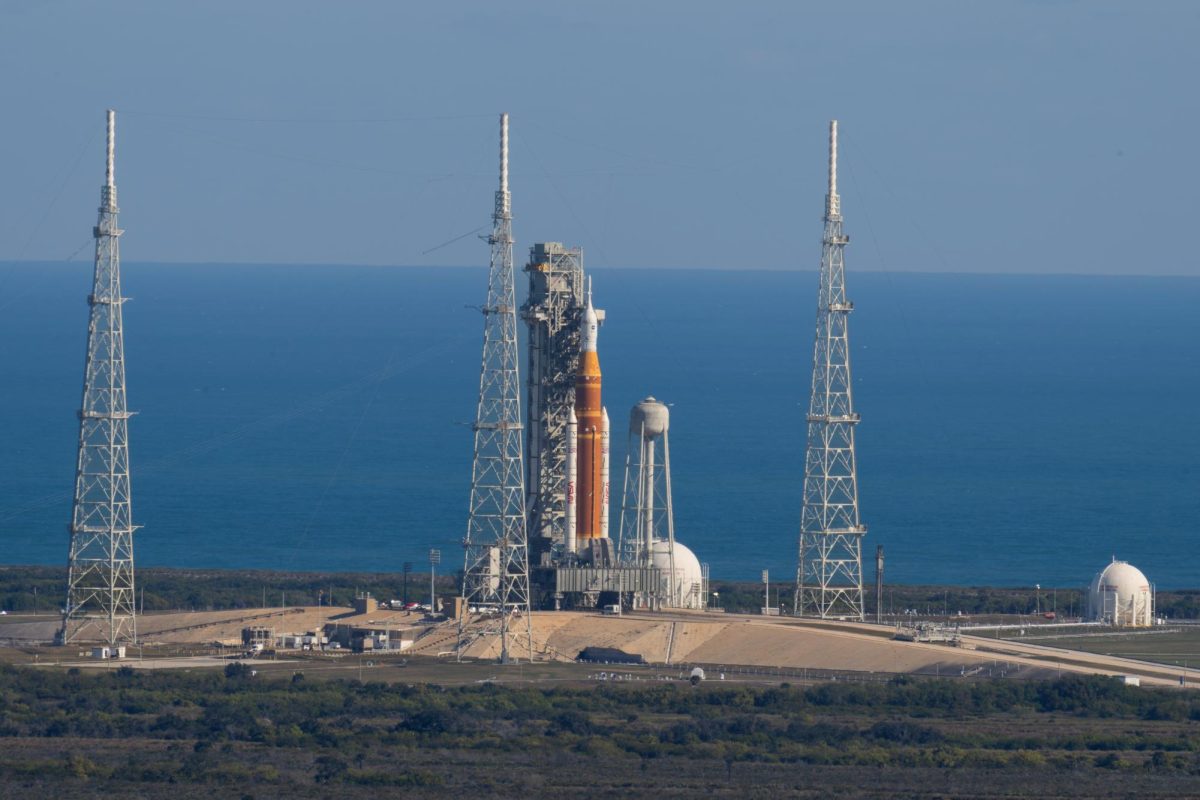
In May of 2019 NASA administration officially announced that the Artemis program was ready to launch. The whole point of the program is to set up a base on the moon and use that as a checkpoint to get to Mars in a series of five separate missions to space over the next two years.
The program started with Artemis Ⅰ which was a uncrewed test flight of the new system, that took place Nov. 11- Dec. 11, 2022. It was aimed at testing the Orion spacecraft and the Space Lunch System (SLS) rocket, making sure that the system and everything was safe for the Artemis Ⅱ crew. Artemis Ⅱ was the next step in the program to take place and will introduce the first human flight of the program to happen.
The Artemis ll crew consisted of four astronauts: Reid Wiseman, Victor Glover, Christina Koch and Jermany Hansen. The goal of the mission was to test the spacecraft with life on board, test new technology and gather data on the far side of the moon.
Another purpose was to test the crew on how they would handle emergency situations. For example, the crew planned to lose connection to mission control when they went around the far side of the moon, and they had to be ready in case any emergency were to happen.
The crew went on a 10 day mission, launching April 1, 2026 at the Kennedy Space Center in Florida, and splashing down April 10, 2026 in the Pacific Ocean. The path they took was around the moon in a figure eight form which included a flyby of the far side of the moon. The spacecraft traveled 695,081 miles in total from launch to splashed down. Overall, the crew of Artemis ll traveled farther than the famous Apollo 13 craft.
The Artemis ll also set other records: traveling the farthest that humans have gone from earth before, Koch being the first woman to travel the farthest in space, and Hansen becoming the first non-American to orbit the moon.
In the end, because they reached several goals and the crew came back safely, NASA administrators considered the mission to be a success. They were able to test the craft and system, they were able to test how well the heat shield responded when they reentered earth’s atmosphere, and they were successful in achieving the flight plan that they had, including the time where they planned to have no communication with Mission Control Houston. They brought back new data and discoveries to help the program move forward to future successes.
Artemis Ⅲ is set to happened next, and it is said to launch sometime in 2027. The mission will be another human test flight, and the crew will be flying in a low Earth orbit. The whole mission will be set to happen in low earth orbit to help eliminate the risks of the mission, and it will allow the crew to be able to focus on the more important tasks.
The point of the third Artemis mission will be to test commercial landers from organizations like SpaceX and Blue Origin, and to test docking capabilities among Orion spacecraft and other private commercial spacecraft. NASA and other organizations are critical partners and will work together to accomplish goals.
Artemis Ⅳ is said to launch early 2028. It will be the first lunar landing of the whole Artemis program. The whole goal of this mission is to land astronauts on the South Pole of the moon. The mission will be exploring the regions of the South Pole, making observations, collecting samples and other data.
Artemis Ⅴ is the last phase in the program that is planned out. Artemis Ⅴ is predicted to take place sometime late 2028, and is aimed to put astronauts on the moon and further Artemis’ Ⅳ goals. NASA plans are to put two astronauts on the moon to collect samples to bring back to earth. Also, starting with this mission, NASA will start exploring ways to begin building a base on the moon.
From Artemis V on, NASA hopes to start doing a lunar launch mission once a year to help further the program. If all goes well NASA hopes to have a base constructed on the moon, and have a checkpoint in place for astronauts to get to Mars. Since 1959, NASA leadership has had their sights set on going to Mars.
It has remained the goal for human exploration because it’s one of the few places where life may have existed and lived within our whole solar system. NASA deemed Mars as an important place to go because of all the valuable resources and data that scientists can gather, and through the Artemis program they strive to make this goal of theirs a reality. Marking another small step for man and another giant step for mankind.